
News
News
Why does Mexico impose tariffs?
Sep 19,2023

Since August 16, the import tariff of 392 customs codes such as steel, rubber, glass, textiles and ceramics has been adjusted to 5% ~ 25%.
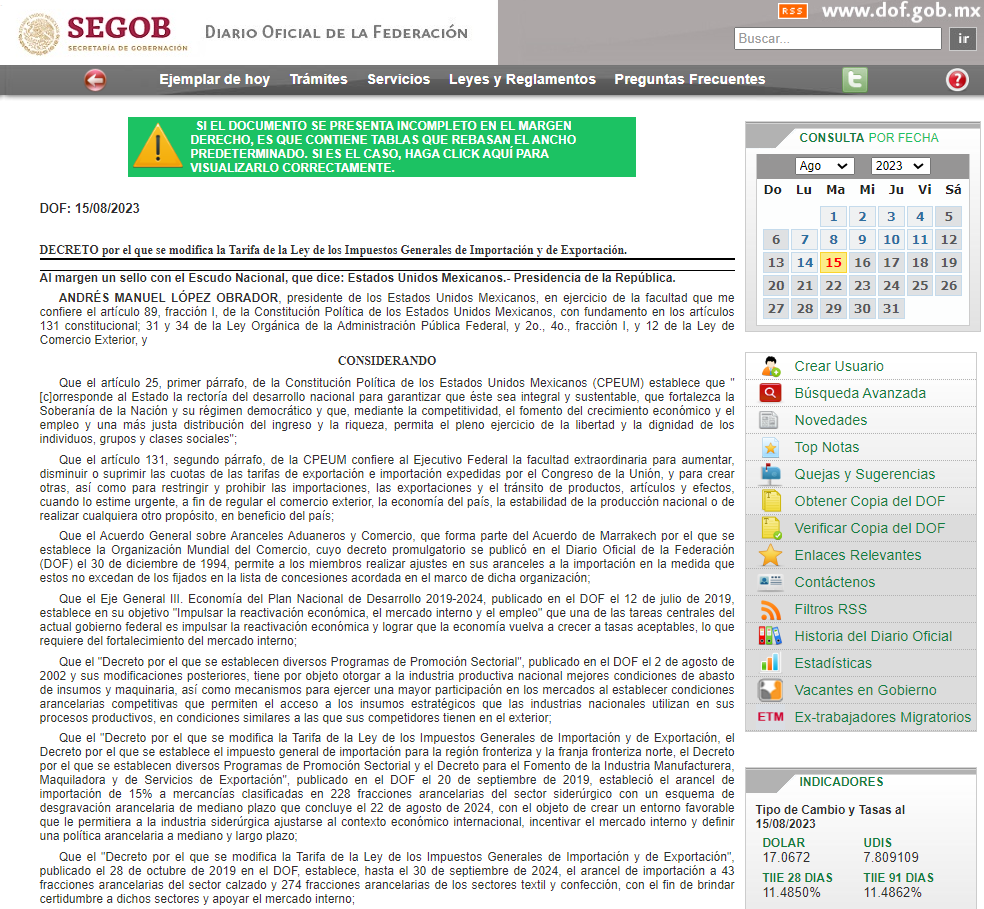
The official link to the decree in Mexico: https://www.dof.gob.mx/nota_detalle.php?codigo=5698661&fecha=15/08/2023#gsc.tab=0Mexico suddenly raises tariffs
According to this law, for any country that has not signed a free trade agreement with Mexico (such as Asian countries led by China), Mexico will have to pay 5% to 25% when importing products from it (the 392 tax items specified in the policy).
 Source: Mechano Think Tank/Trade Risk Early Warning Network
As can be seen from the above chart, for some countries, including China, South Korea and India, strategic industries such as steel, textiles, clothing, footwear, aluminum, tires, plastics, glass and ceramics will be affected by these tariffs. Among them, the import tariff rate is increased to 5 per cent, 10 per cent, 15 per cent, 20 per cent and 25 per cent, but there is a substantial impact, focus on "windshields and other body accessories under 8708" (10%), "textiles" (15%) and "steel, copper and aluminum, metal, rubber, chemical products, paper, ceramic products, glass, electrical materials, musical instruments and furniture" (25%) and other product categories.
As a developing country that accepts investment and shifts its industrial chain, why does Mexico change its tariffs and increase its thresholds? Isn't this detrimental to its own economic development?
The Mexican side believes that the move is to "eliminate trade imbalances".
To put it bluntly, Mexico is still trying to help its own enterprises develop. After the impact of the epidemic and the global economic slowdown, Mexico's market share of domestic products has become smaller, so Mexico hopes to maintain a stable and fair domestic market through tariff adjustments in order to protect and support domestic "fragile" industrial industries.
According to foreign media reports, the Office of the United States Trade Representative (USTR) also issued a statement on the matter, welcoming the Mexican government's move to impose tariffs of up to 25% on steel and other products from non-free trade agreement countries, and inviting the Mexican government to discuss bilaterally to address "the recent surge in imports of steel and aluminum products from the United States,and ensure greater transparency in Mexico's imports of steel and aluminum from third countries。”
In this way, Mexico will also be more stringent scrutiny of imports from different Asian countries, the introduction of this tax policy in line with the wishes of several governments will also be doubtful.
What's the impact?
Since the tariff increase has no warning in advance, Chinese companies that use Mexico as the export market and transfer investment destination country will undoubtedly be affected to a considerable extent. It not only affects the flow of goods between the two countries, but also does not help Mexico to undertake China's industrial and supply chain transfer.
According to relevant statistics released by the General Administration of Customs of my country, China's merchandise exports to Mexico increased from US $44 billion to US $46 billion between 2018 and 2020 to US $67.4 billion in 2021, and further increased to US $77.5 billion in 2022; 2023 In the first half of the year, China's merchandise exports to Mexico have exceeded US $39.2 billion.
It is reported that the 392 tax numbers involve 13 major categories of my country's customs tariff categories. The most affected are "steel and steel products", "plastics and rubber", "transportation equipment and parts", "textiles" and "Furniture Miscellaneous".
According to relevant statistics, in China's export trade to Mexico, these five categories accounted for 86% of the total exports last year. These five categories of products are also the product categories with significant growth in China's exports to Mexico in recent years. In addition, mechanical appliances, copper-nickel-aluminum and other base metals and products, shoes and hats, glass ceramics, paper, musical instruments and parts, chemicals, precious stones and precious metals have also increased to varying degrees compared with 2020.
At the same time, the object of the Mexican side's increase is import tariffs, not additional taxes, which can be levied in parallel with the ongoing anti-dumping, countervailing and safeguard measures. Therefore, products that are under investigation by Mexico or have already implemented anti-dumping duties will face further tax pressure.
At present, the Mexican Ministry of Economy is conducting an anti-dumping investigation on steel balls and tires imported from China, and at the same time conducting countervailing sunset and administrative review on seamless steel pipes from South Korea and other countries and regions. All of the above products are included in the scope of this tariff increase. In addition, stainless steel and coated flat steel produced in China (including Taiwan), cold rolled steel produced in China and South Korea, and seamless steel pipes produced in South Korea, India and Ukraine will all be affected by the tariff increase.



Make global trade unimpeded
Contact Phone


Contact Us


Copyright ©Guangzhou Hongdex International Logistics Co.,Ltd
Hotline: 020-84608598
Whatsapp: 18027165010
QQ:2853396538
Email: 2853396545@qq.com
We will provide you with timely feedback