
News
News
Foreign businessmen can pick up goods without a bill of lading?
Sep 19,2023

Bill of lading BILL OF LADING(B/L) on behalf of the goods, must have enough understanding of the bill of lading.
Basic knowledge and attention points
1. The bill of lading is usually 3 positive and 3 pairs, and there are also 2 positive and 3 pairs.If the letter of credit is required, it should be specifically stated with the freight forwarder.
T/T payment method, in theory, only one original is required (other originals are automatically invalid after picking up the goods, and copies cannot be picked up). After T/T receives all the payment for goods, it can consider leaving one original for itself when sending the original to the guest, and all the others can be sent to the customer (so as not to lose the bill of lading on the way).
2. The carrier (full name) should be shown on the front of the bill of lading.This is what I know, and when I was actually doing the letter of credit, the bank told me that the bill of lading did not show the carrier's safe delivery of the bill of lading (so theoretically it should be shown).
The lower right corner of the front showing the carrier is directly stamped and signed by the carrier company.
If the carrier is not shown on the front and the bill of lading is signed by the carrier, the identity of the signatory shall be indicated at the time of signing the bill of lading.
A bill of lading showing the full name of the carrier but signed by the carrier, which should indicate the identity of the carrier at the time of signature.3. Bill of lading for shipment and bill of lading for shipment:A bill of lading issued after the goods have been shipped. The bill of lading for shipment: the goods issued at the time of shipment only on behalf of the carrier to take over the goods delivered by the shipper, so the bill of lading cannot prove the time of shipment of the goods (the date of the bill of lading for shipment is not the date of shipment).
When the bill of lading for shipment is stamped with "loaded" and the time of shipment is indicated, it can be converted into a bill of lading.
4 The bill of lading cannot have unclean annotations.
5. The consignee and the notice of the bill of lading must fill in strictly in accordance with the letter of credit.
6. Issue, date and number of copies of bill of lading:The bill of lading must be issued by the carrier or master or their agent and should clearly identify the issuer. The general expression methods are: CARRIER,CAPTAIN, or "AS AGENT FOR THE CARRIER:XXX" and so on.
7. If the name of the shipping company (carrier) is printed on the bill of lading, the freight forwarder will generally be carrier as agent for.If the name of the shipping company is not printed on the bill of lading, it must be signed by the shipping company (your ticket should be the shipping company bill of lading signed by the carrier)
8. The discrepancy between the letter of credit and the bill of lading:The carrier is not shown on the bill of lading. After checking, the official explanation is as follows: according to article 23, paragraph 1, of the Uniform Customs and Practice for Documentary Credits, the sea bill of lading must indicate the name of the carrier on its face and be signed or otherwise confirmed by the carrier or as the carrier's named agent or representative, or by the master or as the master's named agent or representative.
9. The issuer of the bill of lading can be divided:FREIGHT FORWARDER B/L refers to a bill of lading issued by a transport company that is engaged in the international carriage of goods but does not own a ship. ORIGINAL BILL OF LADING, commonly known as Haidan.

L/C payment under the conditions of each document production time sequence.
Contract--->Letter of Credit Issuance---> Invoice (the invoice date should be earlier than the date of delivery and the validity of the letter of credit, the date on the commercial invoice cannot be earlier than the date of issuance on the letter of credit, and the invoice date is at the beginning of each document) --->Certificate of Origin(The date of the certificate of origin should be consistent with the date on the invoice you made. The application for the certificate of origin can be applied on or after the day the invoice is made, and the date of issuance is equal to or later than the date of the invoice),Insurance policy, packing list, export license, commodity inspection, other inspection certificate---> Ship Company Certificate(if needed) --->Bill of Lading Day--->Bills of Exchange(Note that the date of the bill of exchange should be earlier than the date and validity of the letter of credit),Certificate of Beneficiary(Some letters of credit do not have a beneficiary certificate, which is covered in the document requirements),notice of shipment(equal to or later than three days after the bill of lading date)Anyway, those documents that need to be submitted have to be dated earlier than the date of delivery.
The above time sequence is basically consistent with the whole foreign trade process. After making a complete order, the details of the whole process will be clear.
The bill of lading is divided into the following three types of bills of lading:
The first is a bill of lading (straight B/L), which is a bill of lading that states the name of the consignee.China's Maritime Law stipulates that the bill of lading shall not be transferred, and the carrier must deliver the goods to the consignee specified in the bill of lading.
The name bill of lading is not widely used in international maritime trade, generally only in the transport of personal belongings, exhibits. (The first TT consignee is directly the name of the customer, not aware of the potential danger: in the absence of collection protection, must not do a named bill of lading.)
In many countries, the consignee of a named bill of lading can take delivery of the goods without the bill of lading, so the bill of lading has effectively lost the right to control the goods. Just like an air waybill, the consignee can pick up the goods as long as he has proof of identity. Even if the letter of credit is settled, the issuing bank is not willing to accept the bill of lading, so the general letter of credit is stipulated as: TO ORDER such a blank head-up bill of lading, thus to control and control the right of goods.
Therefore, it is not only one-sided to remember the non-transferable characteristics of the named bill of lading, but also to remember that "the consignee of the named bill of lading can take delivery of the goods without the bill of lading, so the bill of lading has actually lost the role of the right of goods." This is a crucial point! The concept must remember to be comprehensive, so as not to bring errors and losses to the work. Therefore, if only 30% of the purchase price is collected, and it is the post-T/T 70% collection method, and the designated consignee bill of lading, that is, the named bill of lading, once the customer's reputation is not good and does not pay, it is possible to encounter the situation of empty money and goods. Of course, if you have confidence in the customer and are sure of the collection, it is another matter.
Second, the bearer bill of lading (Open B/L (Blank B/L, Bearer B/L) ), that is, the consignee of the bill of lading column does not specify the name.Such bills of lading can be transferred without endorsement, and the carrier's voucher is released.
The bill of lading that does not specify the name of the consignee on the bearer bill of lading, who holds the bill of lading, who can pick up the goods by the one-way carrier, the carrier delivery is not based on the bill of lading.
The bill of lading indicates in the consignee column: To the order.
Third, the bill of lading, I .e. the bill of lading for the delivery of the goods in accordance with the instructions of the person indicated in the bill of lading.It is a bill of lading commonly used in current international trade.
1, by bank instructions.That is, the consignee column of the bill of lading is filled in as "to the order of xx Bank".
2, with the consignee's instructions.That is, the consignee column of the bill of lading is filled with "to the order of A. B .C. Co. Ltd".
3, with the shipper's instructions.That is, the consignee of the bill of lading is filled in as "to the order of shipper" and is endorsed by the shipper in a blank on the back of the bill of lading. Such a bill of lading may also be endorsed in accordance with the provisions of the letter of credit. The consignee may also not endorse, in which case only the shipper may take delivery of the goods, I .e. the seller retains ownership of the goods.
The so-called no-bill of lading refers to the carrier's failure to deliver the goods on the basis of the original bill of lading.
At present, for the instruction bill of lading and the bearer bill of lading, the carrier must release the goods on the basis of the original bill of lading, the carrier does not release the goods on the basis of the original bill of lading, regardless of the party to which the goods are released, the legal holder of the original bill of lading may hold the carrier liable for breach of contract without single release. This point is unified in China's maritime judicial practice. However, in the case of a named bill of lading, if the carrier does not deliver the goods to a named person with the original bill of lading, can the legal holder of the named bill of lading claim liability for breach of contract to the carrier? At present, there is a negative tendency in theory and practice.
In summary, the domestic cargo owners should be fully aware of the danger of the name bill of lading, the trade buyer's request for the issuance of the name bill of lading as the consignee can not be arbitrarily promised, to ensure that in the case of the settlement of foreign exchange by means of letters of credit and other means blocked, the carrier without a bill of lading to pursue its liability for breach of contract.

Form of issuance of bill of lading
1. Electric release: the original "electric release guarantee" is required ".A letter of guarantee is to issue a statement that this batch of goods what things to put to your customer, and then stamped with the official seal below, passed to the freight forwarder, the rest do not have to worry about. (Of course, the premise of electric release is safe collection! Generally, the electric release is only after receiving the money before TT), the bill of lading is confirmed and shipped, waiting for the freight forwarder to send back the copy of the bill of lading, and then pass it to the customer.2. Sub-order:3-4 days after the ship (when the customer in our and other factories ordered the same cabinet, for the sake of convenience and safety, can be divided into bills of lading, each sent to the customer in the past.)3. Single: Ibid.
4. Release orders in different places:With the consent of the shipping company.
Packing condition
1. Door to Door:It is to order a cabin to the freight forwarder, make an appointment, and then the freight forwarder will send a convoy to your factory, or a designated place to load the goods, and then return to the port.
2. Interior:Refers to the factory directly to the freight forwarding warehouse, and then they help you pull into the port area, the owner has no right to directly into the port area.

Notify the person of the bill of lading that should not be underestimated.
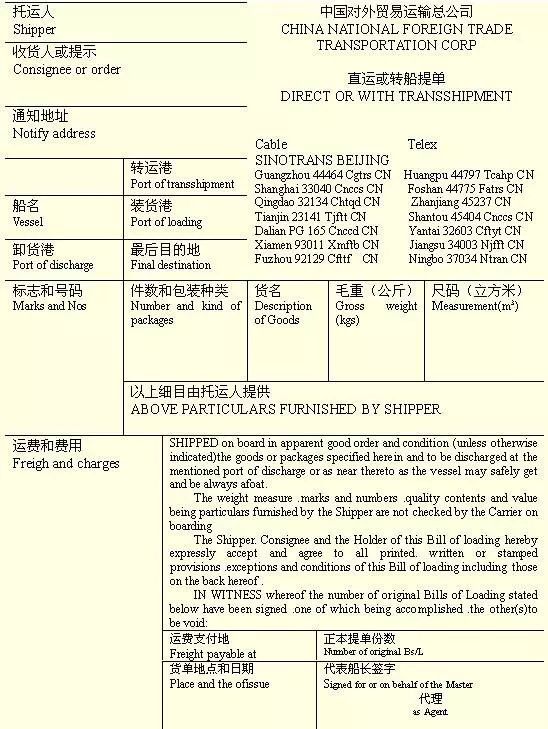
In the sea bill of lading, there is a role that is often overlooked by us, but its importance cannot be underestimated, it is the notification person. Usually, there are two or even three companies to fill in the information section of the sea way bill of lading at the port of destination, usually Consignee and Notify party. Some shipping company bills of lading will also list the First Notify Party and the Second Notify Party.区别Consignee和Notify PartyConsignee refers to the consignee, generally the port of destination customer, that is, the real buyer, the letter of credit payment conditions, generally will be the bank.
Notify party refers to the notifying party, which refers to the contact party of the customer at the port of destination, if the customer himself can fill in the Same as consignee, otherwise it will generally be marked as the customer's agent or trader at the port of destination.
Significance of the existence of the notifying party
After the goods arrive at the port of destination, the shipping company will notify the notifying party of the arrival information as soon as possible, so that the notifying party can notify the consignee to pick up the goods or do other processing. To prevent the delivery of goods is not timely, resulting in detention charges and even huge fines. Therefore, in order to prevent the notification from not being reached, sometimes there will be two notification persons. Because under the payment conditions of the letter of credit, the Consignee on the bill of lading is often the issuing bank, not the real consignee, and when all the documents are handed over to the issuing bank, the issuing bank will notify the real consignee for negotiation and other processes.
Fill in not at will
In many cases, the notifier is treated as a notifier without knowing or communicating in advance, resulting in the arrival notice not reaching the consignee in time, resulting in delays in picking up the goods and additional costs. This requires that when confirming the bill of lading, the notifying party column should also pay special attention and should not be arbitrary.
About to orderSometimes we come across a To order bill of lading. To order bill of lading refers to the instruction bill of lading. The general format is 'To order of xxx', which requires an endorsement of 'xxx' to transfer or pick up the goods. If there is only 'To order' in the consignee column on the bill of lading, this means 'To order of shipper' and requires an endorsement of 'shipper. The notifier only serves to notify the consignee and has nothing to do with the endorsement.
Questions about the notified person
1) If the consignee of the bill of lading and the notifier are inconsistent, who is the general notice of arrival of the goods sent?Usually the consignee is notified. Most bills of lading use the information of the notifying party as the main information for the ship agent to contact the consignee at the port of destination. Because most of the consignees of bills of lading are To order, they are not directly named. Sometimes, the notified person cannot be contacted and will find the consignee or contact the consignor if necessary.
2) Who should I give the bill of lading?
Consignee. Whether it is the original or the electric release, it is a transfer of property rights, which is basically to be transferred to the hands of the property owner. The real right to goods is the consignee.
3) Is it okay for both the consignee and the notifying party of the bill of lading to order?
On the surface, this is easy to operate and can be transferred to any consignee. However, in practice, the general shipping company stipulates that the consignee of the bill of lading and the notification person cannot be To order at the same time. There can only be one, which is also to prevent freight risks.
4) The customer's letter of credit requires the bill of lading to notify the person column to write two companies together, is that OK?
Some shipping company bills of lading will have a first notifier and a second notifier, if not, you can fill in two companies under one notifier.
5) In the case of the consignee To order, can the notifier on the sea bill of lading pick up the goods?
No, when the consignee of the original bill of lading of the shipping company is To order, the consignor does not endorse and send it to the customer, and the consignee cannot mention it, let alone notify the person.
6) Customer's request, the notifier column of the bill of lading shows To order, is that OK?
Better not to order. After all, the role of the notifier is to keep abreast of the arrival of the goods and notify the consignee to receive the goods in time. If not, the general notifier can write the Same as consignee.
7) The consignee of the bill of lading is To order, and the notice is Same as consignee.
If the consignee is To order, be sure to provide a Notify party with specific contact information, otherwise after the ship arrives at the port, the goods will not be picked up due to the inability to notify the importer or the relevant responsible party, and may even lead to serious consequences such as confiscation by the customs. If it is to declare AMS/ACI, it may also result in a huge fine imposed by the other customs.
8) Does the To order bill of lading need to be endorsed by the notifying person?
If the consignee of the bill of lading is To order and there is no other content afterwards, such as: not To order of the XXX, then this is called a blank indication bill of lading and needs to be endorsed by the Shipper (consignor). The Notify party is the notifier at the port of destination and has nothing to do with the endorsement.
9) The goods have arrived in Hong Kong. The customer said that the head of the notifier was not fully written and asked to change the order, otherwise customs clearance could not be made. Does it really affect?
Notifier head-up error will not affect, as long as the consignee on the bill of lading is correct, the notifier information as long as it does not affect the authenticity of the determination, will not affect the port of destination customer customs clearance to pick up the goods.

FAQ
1. Why do foreign businessmen sometimes take delivery of goods without a bill of lading?

We know that the bill of lading should theoretically be a "document of title", that is, who "legally obtained" the bill of lading, who is equal to the goods.
The bill of lading has the consignor (exporter) Shipper, the carrier (forwarder/shipowner) Carrier, the consignee Consignee, the notifying party Notify Party quartet. The "consignee's Consignee" determines the ownership of the goods.
"Consignee Consignee" is usually filled in two ways:One is "by instruction (TO ORDER or TO ORDER OF...)", that is, who is the consignee has not yet been determined, this bill of lading can be freely transferred by endorsement (the original holder signs on the back of the bill of lading, indicating the transfer), more valuable ----- because who "legally" get the bill of lading, the goods are whose. Such a bill of lading is a "bearer bill of lading". In the operation of bearer bills of lading, foreign businessmen do not have the right to take delivery of the original bill of lading (unless the freight forwarder and shipping company mess up, illegal no single release), very safe, recommend everyone to use. Under a letter of credit, the bank will usually also require such a bill of lading. The other is the named bill of lading, that is, the "consignee Consignee" column specifies the consignee's company address (usually foreign), only this company can pick up the goods. Because the consignee is specified, it is useless for others to get the bill of lading, and the bill of lading cannot be transferred. On the other hand, because it is stipulated that the consignee is dead and only he can pick up the goods, some countries recognize that even if the consignee does not have the original, he can pick up the goods as long as he proves his identity. This is why we will encounter foreign businessmen in the business did not get the original bill of lading can also take delivery of the reason. In this case, the goods to the freight forwarder to issue a named bill of lading, almost equivalent to direct delivery to foreign investors. If the payment is not recovered at this time, there is a certain risk that the payment will depend on the foreign businessman's consciousness. The named bill of lading also loses the effect of the "document of real rights.
2. Which countries can pick up the goods without the original bill of lading?

Not all countries can pick up the original (named bill of lading).
At present, there are two mainstream legal systems in the world, the common law system and the civil law system. Among them, only the common law system, in the past considered that the name bill of lading is not a document of real rights. Therefore, common law countries are prone to the phenomenon of private pick-up under a named bill of lading.
Common law countries are:
United States, Canada, United Kingdom, Australia, New Zealand, India, Pakistan, Bangladesh, Malaysia, Singapore, Bahamas, Botswana, Brunei, Cameroon, Cyprus, Fiji, Gambia, Ghana, Grenada, Guyana, Jamaica, Kenya, Kiribati, Lesotho, Maldives, Malta, Mauritius, Mozambique, Namibia, Nauru, Nigeria, Seychelles, Sierra Leone, South Africa, Sri Lanka, Swaziland, Tanzania, Tonga, Trinidad and Trinidad and Tobago, uganda and so on.
When you have doubts, you can check online whether the foreign merchants belong to common law countries.
However, even in common law countries (including the United Kingdom), there has been some jurisprudence in recent years that a named bill of lading is also a document of title. In the common law system, the case is the law, which can be seen as a turning point. Even so, we should be cautious. After all, prevention is the main thing. Once an accident occurs, even if the lawsuit is won, the loss outweighs the gain for the vast majority of small and medium-sized export enterprises. What's more, it may not be possible to win. Foreign businessmen who are more experienced can easily turn lawsuits into commercial disputes and wrangle for several years.
Therefore, for unfamiliar foreign businessmen, especially D/P, it is best to use registered bills of lading with caution. In fact, registered bearer will not cause too much inconvenience to foreign businessmen in serious business operations.
3, freight forwarding bill of lading and shipowner's bill of lading is the same thing?

In practice, we will encounter two types of bills of lading: shipowner's bill of lading and freight forwarder's bill of lading. The shipowner is the freight company that has its own ocean-going freighter. An ocean-going freighter costs a lot of money, and companies with their own ocean-going fleets are naturally strong. In a sense, such companies are also more acceptable *, because they pay more attention to reputation in long-term business, and will not destroy their reputation for a little profit. Relatively speaking, they are more formal in operation. Another kind of freight forwarding company is freight forwarding, referred to as freight forwarding. The freight forwarder does not own a ship, which is similar in nature to an ordinary trading company in a sense. After they solicit the goods, they take them together to the shipowner to book the cabin. Let's think of the difference and relationship between shipowners and freight forwarders as wholesalers and retailers, and the goods are the "cabins" of ocean-going freighters ". The shipowner wholesales the shipping space to the freight forwarder, and the freight forwarder retails the shipping space to us.
It is not difficult to imagine that although the shipowner is safe, it is inevitable that the "shop will put a lot of pressure on customers", and the flexibility and courtesy of service are often not as good as those of freight forwarders. The number of freight forwarders is large and widely distributed. It is very convenient to communicate with us in foreign trade, and we are more willing to cooperate with our operations, especially the special operations mentioned above such as "reverse bill of lading. Therefore, it is more common for us to deal with freight forwarders in actual work.
On the surface, the effect of the shipowner's bill of lading and the bill of lading is similar, we sell the original bill of lading to foreign investors, foreign investors with the bill of lading to pick up the goods. There is actually a difference. First of all, the bill of lading itself is a "contract of carriage", the shipper to the bill of lading to us, is tantamount to signing a contract of carriage. The shipowner's bill of lading is a contract between us and the shipowner, but the freight forwarder's bill of lading is not. We give the goods to the freight forwarder, the freight forwarder and then to the shipowner, the freight forwarder and the shipowner has a carrier agreement, the shipowner is only responsible for the freight forwarder and not to our shipper, because under the operation of the freight forwarder bill of lading, for the shipowner, the freight forwarder is the "shipper".
Therefore, with the shipowner's bill of lading, to the port of destination can be directly picked up; and the freight forwarder bill of lading is not, need to take the freight forwarder bill of lading to the port agent there "for a single", that is, according to the freight forwarder bill of lading issued a notice of pick-up, and then to pick up the goods. Of course, for us to pick up the goods, this is ostensibly an extra procedure, does not affect the pick-up, is not a risk. On the contrary, we can use this to better control property rights. For example, when we hand over the freight forwarder bill of lading to the customer, we suddenly find that the customer has committed fraud and may not pay the money. At this moment, we can ask the freight forwarder for help and notify the agent of the destination port to "hold" the goods so that foreign businessmen can not bring the goods temporarily even with the freight forwarder bill of lading, thus giving us precious time (without formal reason, the destination port is inconvenient to forcibly deduct the goods, only for a few days, but for foreign trade disputes, this delay is very beneficial to exporters).
In short, if something happens to the cargo transport itself, when we pursue the responsibility of the freight company, it is clear that the strong shipowner is more capable of being responsible than the ordinary freight forwarder. Usually freight forwarders than shipowners can cooperate with our work, in the flexible handling of bills of lading and prevent commercial fraud, the help of freight forwarders is very important. In addition, the freight forwarder's transportation price is also very advantageous, often discounts.
The operational difference between MBL and HBL: MBL is the bill of lading for the shipping company; HBL is the bill of lading for the freight forwarder.
1. SHIPPER pass the consignment slip to the FORWARDER, stating whether it is full or LCL.
2. FORWARDER to the shipping company to book the cabin, after the ship ON BOARD. The shipping company issues an MBL to the FORWARDER. The SHIPPER of MBL is the FORWARDER of the port of departure, and CNEE is generally the branch or agent of the port of destination of the FORWARDER.
3. FOWARDER sign HBL to SHIPPER. HBL's SHIPPER are real cargo owners. CNEE generally makes letters of credit to ORDER.
4. CARRIER ship the goods to the port of destination after the ship has sailed.
5. FORWARDER send MBL to the destination port branch through DHL/UPS/TNT, etc. (INCLUDING:CUSTOM CLEARANCE DOCS)
6. After the SHIPPER gets the bill of lading, it will pay the bill to the domestic negotiating bank within the delivery period and settle the foreign exchange. If you do T/TSHPPER send documents directly to foreign guests.
7. The negotiating bank shall settle the full set of documents with the issuing bank.
8. CNEE pays the issuing bank for the ransom.
9. FORWARDER take MBL to the shipping company for a single pick-up, customs clearance.
10. CNEE takes HBL and takes delivery to FORWARDER.
Previous Page:



Make global trade unimpeded
Contact Phone


Contact Us


Copyright ©Guangzhou Hongdex International Logistics Co.,Ltd
Hotline: 020-84608598
Whatsapp: 18027165010
QQ:2853396538
Email: 2853396545@qq.com
We will provide you with timely feedback