
News
News
A 13.62% plunge! Four major routes' freight rates all fell... | Maritime export logistics
Mar 27,2025

On the sea of international trade, China's export container price index, like a ship that ebbs and flows in the waves, has recently gone "against the wind," and has plunged ten times in a row, casting a cloud over the entire shipping market.
Looking back at the crucial node on March 21, according to the authoritative SCFI published data, the freight price index stood at 1,2292.75 points, compared to 1,319.34 points in the previous period, as if the climber had lost his footing and fell, dropping 26.59 points at once. Although the decline narrowed slightly to 2.02% from last week's "frightening" 8.14%, the overall freight price market remained mired in a slump. 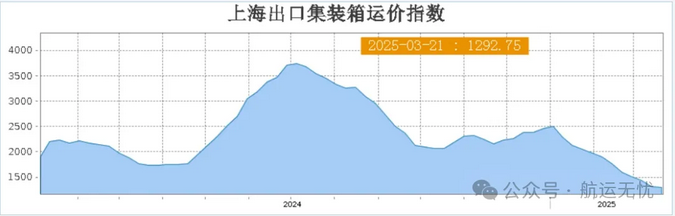
Focus on the four major ocean routes in Europe and the US, which are the driving forces of global shipping, and which are tired old horses, fares are weak, all lower than at any point in 2024, and the decline has not stopped.
The US-Spain route has been hit hard, with freight prices approaching or even falling below the cost bottom line of some carriers, and every container is transported as if it is "losing money." The European route is no better, with freight prices struggling and hovering near cost prices, leaving shipping giants scrambling.
Under pressure, the Mediterranean Shipping, Hapag-lloyd and other industry giants have to "rescue the market." The original plan in early April in the United States line shouted, a substantial increase in freight rates, each FEU intends to pull up $1000-1100, trying to pull up the spot price of this "straw," to stabilize the long price of the ship. The ideals are full, the reality is emotional, and the market does not play by the script. 
Take the South American line, which has a "staggering" decline this round, with a loss of 13.62%, like a steep cliff, making practitioners scared.
In terms of European lines, the freight rate from Shanghai to Europe is $1306 / TEU, and each data update is like salt in the wound, down 2.68% from the previous period;
Shanghai to the Mediterranean rate of $2,195 / TEU, also not immune, down 4.36%.
Mediterranean shipping wanted to raise prices to save itself, but there were fewer ships and large ships, so to not allow the cabins to be too empty, it was only able to carry on with the late March offer in the first week of April. The early April price increase was put on hold until the market changed.
Although freight prices are relatively stable, they also fluctuate in the wind and rain. Shanghai to the United States West, the United States East freight rates were 1872 US dollars / FEU and 2866 US dollars / FEU, each data is also all down arrow, down 4.73% and 3.73% respectively from the previous period. However, there is always a glimmer of light in the darkness, and some senior industry insiders are keenly aware that US line freight prices have tentatively recovered from the bottom.

Behind this, several waves of tariff wars in the United States have upended the market. The previous wave of tariff-evading shipments caused overall U.S. import volumes to surge 9 percent year-on-year in the first two months of February, second only to the madness during the epidemic. Now, the market is eagerly awaiting the boots of the US equivalent tariffs to land on April 2, and once the dust has settled, orders will come in like snow, and volumes are expected to rebound strongly.
It is forecast that freight prices on the US West line are expected to return to a high of $2,650 in mid-April, and the US East line is expected to soar to $3,650, giving practitioners a reassurance.
Behind the big chess game of transportation is a fierce competition between many forces. Shipping veterans know that the impact of the tariff policy is like a double-edged sword, which is short-term negative, and cargo owners are frightened by the uncertainty, ship cautiously, and shipments shrink. However, in the long run, once the tariff war negotiations come to an end, the market enters a rhythm of adjustment, the volume will gradually regain its strength, and the rebound of freight prices is also a likely event. 
The disaster is not alone, but the Red Sea crisis in the Middle East recently flared up again, like a "time bomb" at sea, where ship scheduling suddenly turned into a pot of porridge and capacity was blocked. However, in another way, this also hides an opportunity, as capacity constraints will certainly be a booster of higher freight prices as soon as cargo volumes pick up.
Looking ahead to the aggregate supply and demand of the transportation market in 2025, Alphaliner's forecasts are a wake-up call: capacity supply is rising at a high rate of 5.7 percent, while demand is trickling down to only about 2.5 percent. Oversupply pressures remain heavy on the market, although the growth rate is tempered from 2024.
However, be cautious. If the Red Sea crisis eases and a large number of new ships are delivered in a concentrated manner, the freight prices will be shocking. In addition, the whims of China-U.S. tariff policies and the smoke of the Russia-Ukraine conflict may cause the cost of detour to soar and disrupt regional trade flows. 
The reality also confirms the stagnation of the market, although shipping companies vowed to increase freight rates at the beginning of the month, the actual transaction price in the first week of April was like being charmed, continuing the offer at the end of March, and the freight rate remained unchanged.
Take a closer look at each route:
The freight rate from Shanghai to Europe is 1,306 USD/TEU, with a stable "blood loss" of 36 USD per week, a weekly decline of 2.68%;
The freight rate from Shanghai to the Mediterranean is 2,195 USD/TEU, a drop of 4.36% per week, like a hundred-dollar bill.
The freight rates from Shanghai to the US West Coast and the US East Coast are also difficult to reverse the downturn, falling by $93 and $111 respectively, with weekly declines of 4.73% and 3.73%.
Of course, there are exceptions, the freight rate from Shanghai to the Persian Gulf is 1,059 USD/TEU, an increase of 83 USD, a weekly increase of 8.50%;
The freight rate from Shanghai to Australia and New Zealand is 755 USD/TEU, a small step forward, an increase of 20 USD, a weekly increase of 2.72%;
The Shanghai to Japan freight rate index was 970.34 points, the transportation market was generally stable, and the market freight rate was stable, which left a rare piece of peace in this turbulent shipping world.



Make global trade unimpeded
Contact Phone


Contact Us


Copyright ©Guangzhou Hongdex International Logistics Co.,Ltd
Hotline: 020-84608598
Whatsapp: 18027165010
QQ:2853396538
Email: 2853396545@qq.com
We will provide you with timely feedback