
News
News
The cross-border e-commerce circle is in an uproar! The 800 USD tax-free policy is expected to be postponed until September?
Mar 18,2025
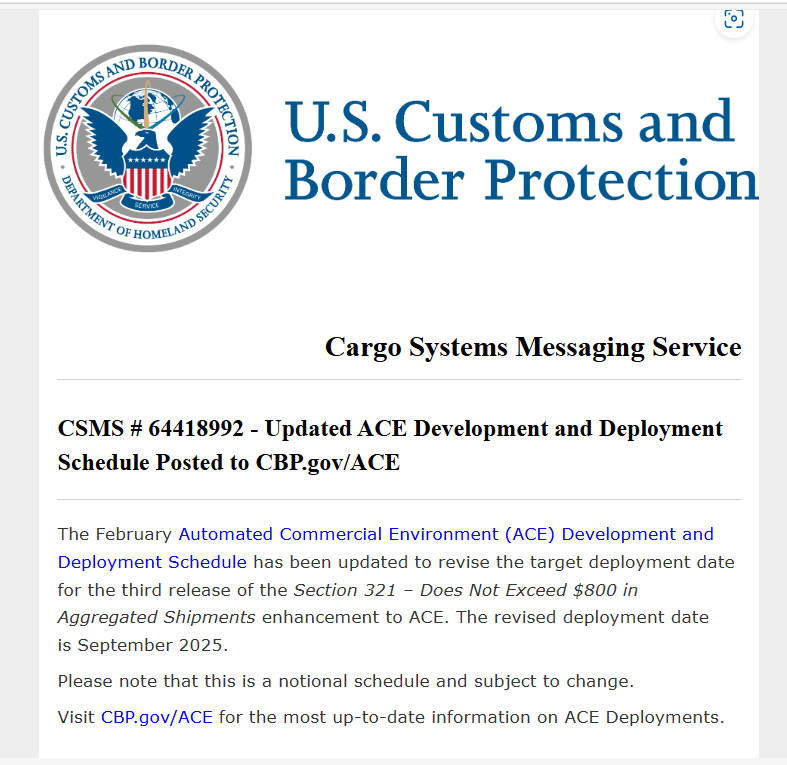
On March 17th in America, a blockbuster announcement from CSMS, like a stone in the lake of cross-border e-commerce industry, stirred up a thousand waves.
The announcement focused on a project called "Business Environment (ACE) Development and Deployment Plan," and its critical deployment time node was set in September 2025, instantly attracting the attention of countless practitioners. Read through the central points of the announcement, and change is already coming.
First, the filing process welcomed a new variable with the addition of the "expected arrival time" field. This seemingly minor adjustment will have a profound impact on the co-ordination of logistics and customs clearance, and sellers must take this factor into account in subsequent arrangements for the shipment of goods, and accurately estimate the arrival node to ensure smooth declaration.
Second, an early warning "red line" was quietly drawn. When one day or one person imports exceed the $800 limit, the ACE system will immediately sound the alarm.
This means that the operational space for some sellers to "go the wire" using small import tax-free quotas has been greatly compressed in the past, and once an early warning hits, the subsequent customs clearance process will inevitably face more strict scrutiny, and a slight incident may encounter the difficulty of stranding goods and soaring additional costs.
Furthermore, compliance regulation has been upgraded across the board. Even within the $800 exemption, the ACE system will strictly control non-compliant goods.
Some of the tactics used in the past to try to skirt the margins and confuse the border will completely fail, and the "hot eye" of customs will penetrate the appearance of exemption and hit the essence of the goods, and only fully compliant goods will be able to pass smoothly.
It is worth noting that the Automated Business Environment (ACE) development and deployment timelines have been updated. The target deployment date for the third release of ACE Section 321 - enhancements with a total shipment of no more than $800 - was set at September 2025, but officials also made clear that this was a conceptual timetable that could change at any time.

The announcement instantly sparked a heated discussion among sellers. Many sellers were hopeful that the $800 waiver could be extended until September, as if they had seen a temporary haven in the stormy trade routes. After all, this policy is in the vital interest of many small and medium-sized cross-border e-commerce sellers, and every additional day of survival will save them a lot of costs and maintain their operating cash flow.
However, a calm voice also exists. Some sellers pointed out that the CBP announcement focused on the system deployment update, and did not directly indicate that there is a direct connection with the "cancellation of $800 tariff exemption." In other words, the $800 waiver, the high-hanging sword of Damocles, could still fall without warning, eliminating the risks with it.
Looking back, the tariff wave is like a raging sea wave, which has repeatedly hit the banks of the cross-border e-commerce industry. From the initial shock of hearing the policy change, to the panic of worrying about the future, to the gradual calm of some practitioners today, there have been countless days and nights of pain and searching. Fortunately, the T86 suspension of the cancellation, as to the industry into a shot in the arm, so that we won a respite, many sellers seize the time to prepare response strategies.
Senior sellers in the industry also teach their experience: once the T86 is finally cancelled, it is safer to rely on the customs clearance mode of T01 and T11 for commercial express delivery. Both models have been tested in long-term practice in process standardization and customs clearance efficiency, and can minimize the risks posed by policy changes.
However, caution must be exercised when it comes to the seemingly "short-cut" way of circumventing customs through transit countries. Behind the seemingly cost-saving and regulation avoidance, there are many gray areas hidden behind them. Once the customs are found, not only will the goods be lost, but they may also face a huge fine, even be put on a trade blacklist, completely cutting off the path of cross-border e-commerce. In this volatile cross-border trade battlefield, only compliance with regulations and keeping up with the trends of policy can we achieve steady progress.
Previous Page:



Make global trade unimpeded
Contact Phone


Contact Us


Copyright ©Guangzhou Hongdex International Logistics Co.,Ltd
Hotline: 020-84608598
Whatsapp: 18027165010
QQ:2853396538
Email: 2853396545@qq.com
We will provide you with timely feedback